To summarise in a single sentence
"Defacto2 is a web site that is dedicated to the preservation of the computer underground counterculture, with a focus on the PC cracking scene."
The computer underground counterculture is what is generally known as 'the scene'. The scene is comprised of many different elements that are loosely banded together. These elements are often comprised of the following..
The creation of computer-based artwork using different media and techniques such as the example on the right from ICE circa 1992. It is using computer ANSI characters to give the illusion of an image.
[extra info]
The art of modifying software. This can vary greatly from something simple as creating a
trainer, enabling cheating within a game. To complex solutions such as removing software,
CD or DVD copy protection. In most countries the act of cracking itself is not illegal. It's only when you apply the cracks on an item to
render it free and stolen that it becomes illegal. This distributed cracked software is then referred to as
warez.
The combination of art, music and programming trickery to create a visually appealing non-interactive computer program.
[extra info]
The duplication of functionality of one system within another. An example would be a Nintendo Gameboy emulator that enables you to run Gameboy games on your Windows PC.
[extra info]
The unorthodox manipulation or exploration of anything computer related.
[extra info]
The creation of computer generated music using tracker modules.
[extra info]
The now redundant art of the exploitation of telephone systems to obtain free phone calls. Often used back in the old
BBS days when calling boards over long distances was prohibitively expensive.
[extra info]
The releasing of copyrighted and often cracked software, movies and music to make available to the general public at no financial cost.
[extra info]
This loose grouping comes from the fact that most of these scenes originate from a similar lineage.
Back in the old days before the internet was accessible to the general public, BBS systems were the main means for savvy computer users to communicate.
While we won't go into detail about
Bulletin Board Systems.
It is fair to say that BBSes often wanted to value add their services, to encourage people to call their boards.
So unlike many web sites of today that are very specific and often niche,
BBSes systems commonly covered a variety of topics and offered numerous files. Which in turn helped to create small localized BBS communities with a broad appeal.
This convergence of the intertwined, overlapping scenes means they often got grouped together and referred to as
the computer underground.
I might also add that the legality of some of these elements can be questionable.
Of cause that's not to say that they all are.
It is just if you were to categorize the elements the results would vary.
Phreaking and Warez are definitely illegal, and do attract the attention of law enforcement agencies.
Hacking, Emulation and Cracking are considered grey areas, dependant on their use and implementation.
Art, Music and Demos are perfectly legal and often the people involved eventually work in related commercial industries.
'Dedication to the preservation of the computer underground counterculture, with a focus on the PC cracking scene'.
Well firstly lets clarify that PC means a personal computer that runs a version of Microsoft Windows.
Or before Windows was popularized, it meant a computer that was
IBM-PC compatible that ran
MS-DOS (or something similar).
So to summarise Defacto2 documents and hosts the legal off-shoots that are derived from the PC cracking and warez scenes.
This means all the text files, demos, music, art, magazines and products that are cracking related but are not illegal in themselves will be hosted and discussed here.
To be honest, because no one else has and then eventually this element of the computer underground will be lost and forgotten.
All the other scenes have plenty of available information and dedicated web sites.
But due to the nature of the robin-hood cracking with it's high churn rate for participants, this is a scene that is not well documented nor understood.
As a side note, we ourselves do not actually participate in or support software piracy.
We actually do believe in supporting software developers and can honestly say that all the tools used to create this site were done with either purchased software,
registered shareware or
open-source programs.
Jason Scott is the producer of the excellent and well received BBS Documentary and Rad Man is the founder of the most well known art scene group of all time, Acid. Together they teamed up at the Notacon Conference in Cleveland during late April of 2004 to give a 50 minute presentation on the topic.
The presentation itself was recorded and can be downloaded and listened to in MP3 format, plus there is a text transcript available. The site itself also has some excellent examples of early computer artwork, from early main frame printouts to massive modern ANSI (such as the one above).
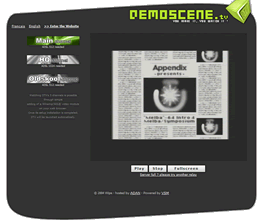
Three TV channels broadcasting 24 hours a day over the web of purely demos. We recommend you check out the oldskool channel to get a feeling of the old demo scene. It does require Winamp/AOL© video module plug in and a broadband connection.
This is a 220 page hardback book is a in depth look at both the Commodore 64 and Amiga demo and cracking scenes. Their history, dominance and their influence. The book contains a lot of text as well as many photos and is the best primer available for anyone interested in the scene in general. As the Commodore 64 was the pioneering scene that introduced many of the concepts that are taken for granted today. While the Amiga evolved those notions and produced an even more professional and competitive outlet.
A great tutorial and summary on ascii art scene by Roy of SAC. The now legendary artist who has been commissioned by numerous famous and respected groups over the years including Razor 1911, Drink or Die, RISC, TRSI, Deviance, Origin and The Humble Guys. For further reading the site also has a large number of links to more detailed web pages that cover the subject of ascii and ansi art in more depth.
"Ever since the days of the IBM PC 8088 and C64, personal computers have been used for much more than word processing and data entry. Artists around the world have found computer art to be less expensive and much less restrictive than traditional paint and canvas. These artists have pioneered many different electronic art mediums over the years, the most popular of course being High-Resolution images and Three-Dimensional Renderings. Primitive mediums such as ASCII and ANSI text, and RIPscrip are still popular, but have moved far away from the mainstream and into this little niche we call the digital 'ArtScene'.."
Defacto was founded in late February or early March of 1996 as an underground electronic magazine.
The original intention was to fill the gap left by a former leading magazine
Reality Check Network after their initial closing.
While our magazine never gained the following that RCN commanded, it was generally considered a decent alternative.
After eight public issues the magazine vanished, only to later return with a new format and a new name Defacto 2.
Defacto 2 was a monthly text based magazine that was eventually meant to evolve into coded and html issues.
The magazine unfortunately only lasted three issues but these issues at the time were packed to the brim with scene related articles and interviews.
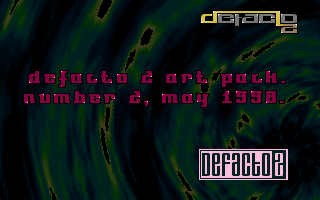
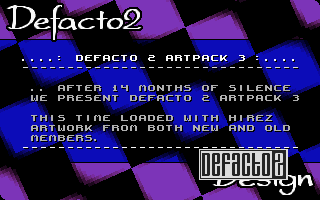
While the name lasted, the magazine didn't and in late 1997 we became a moderately successful art group.
Initially lead by Ipggi and later by Seffren the group was unique in the fact that it didn't demand membership exclusivity.
So many of our members were also co-members with other popular groups of the time such as X-Pression and SAC.
While obviously you can find some of our work below, many of our members also did a number of side projects that would be familiar to the scene.
For example Antibody's ascii header for Class (one of the most predominate groups of all time) can be seen in every one of their NFOs since 1998 till their retirement six years later.
So if you ever see the tag [df2] in an old NFO or release package, it most probably was done by one of our art members during this period.
Unfortunately after three years and a few sporadic releases the group was put to rest.
Seffren, the leader had decided it was time to move on from the scene and try some new things in life.
So at the end of the millennium the final release, Art Pack 5 was made public.
 about?
 Demoscene.TV